
TPE #145: Why Bid Adjustments are dead and what to do instead
May 04, 2026Read time: 4 minutes
GM, Miles here!
I still see a lot of Google Ads Specialists who try to improve results by adding bid adjustments to their campaigns.
Back in the day, setting bid adjustments had a big impact on performance.
You'd open a campaign, calculate the right multipliers for mobile, desktop, and tablet, set time-of-day adjustments, layer in audience and location adjustments — and that gave you a big edge. Doing it well separated the good specialists from the average ones.
But today, most of those adjustments are being ignored. It surprises me how many people are unaware of that.
If you're running the most popular Smart Bidding bid strategies like Target CPA, Target ROAS, Maximize Conversions, or Maximize Conversion Value — which is most accounts in 2026 — Google just ignores most of the bid adjustments you set. The bid adjustment menus still exist in the UI, which makes it feel like you have those controls...
But they don't work in most cases.
Today, I'm sharing the full breakdown of where bid adjustments still work, where they're being ignored, and what to use instead — so you can stop wasting time on things that don't work (and start doing the work that actually matters).
Let's dive in!
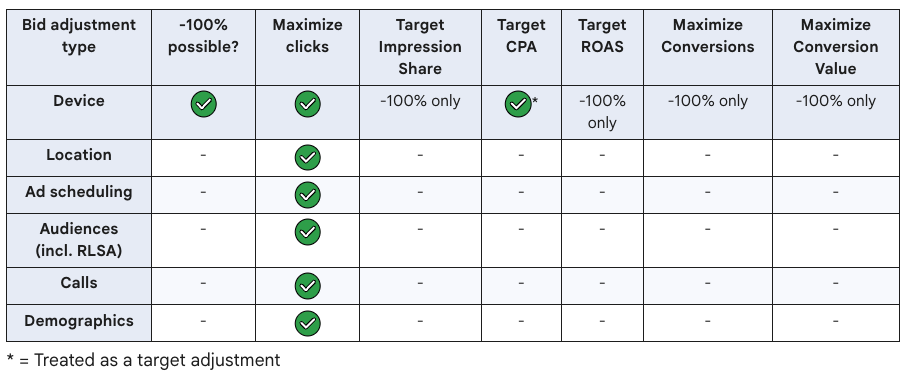
When bid adjustments work, and when they don't: save this table.
Real quick: for this guide, I'm referencing bid strategies that are available in the most commonly used performance-driven campaign types: Search, Shopping, Demand Gen, and Performance Max. Video campaigns have a few unique bid strategies that I won't cover.
This table explains everything you need to know, but I'll break it down below.
The bid strategies that still respect your bid adjustments:
-
Manual CPC
-
Maximize Clicks
If you're running any of these, the old playbook still applies: set your adjustments for devices, time-of-day, locations, audiences, and demographics. Stack them carefully though, because adjustments compound.
For example: you set +25% for mobile, +15% for evenings, and +10% for users in Amsterdam. A user who hits all three signals gets a bid that's 25% × 15% × 10% layered on top of your bid. These stack quickly so you run a real risk of overbidding.
If you're still running Manual CPC or Maximize Clicks, bid adjustments are part of your work.
When bid adjustments are ignored by Smart Bidding.
The five most used Smart Bidding strategies mostly ignore your bid adjustments:
-
Target Impression Share
-
Maximize Conversions
-
Maximize Conversion Value
-
Target CPA
-
Target ROAS
Even if you do all the hard work and put in endless hours calculating the right adjustments, Google will simply ignore them.
Smart Bidding evaluates a much larger set of signals than the regular bid adjustments we have access to: operating systems, demographics, conversion path history, deeper audience segments, device type, language, browser, and many more. Smart Bidding looks at all of it at auction time and sets the optimal bid for that auction in milliseconds.
That's all you need to know: Smart Bidding ignores your bid adjustments in most cases.
So if you're still spending hours on adjustments under any of the strategies above, you're literally wasting your time.
The exceptions: Maximize Clicks, tCPA, and devices (but only limited).
There are a few exceptions when bid adjustments DO work with Smart Bidding:
-
Maximize Clicks respects all your adjustments.
-
Device adjustments with Target CPA are treated as a target adjustments.
-
Device adjustments are respected with a -100% adjustment on all Smart Bidding strategies (technically serving as an exclusion).
These are the only exceptions. In all other cases, Smart Bidding ignores your adjustments.
Even though I would advise against using -100% device bid adjustments, there are a few scenarios when it would make sense to exclude certain devices:
-
If your tablet traffic converts at a fraction of the rate of mobile or desktop
-
A mobile experience that's broken and you can't fix it quickly
-
A B2B campaign where desktop is the only relevant device
But... This exposes the real problem and you should prioritize fixing those ASAP. Excluding devices should only be a temporary fix, not a long-term solution. The customer journey is super complex and every touchpoint/device plays an important role in the process. Just because many B2B customers convert on desktop, doesn't mean you can ignore mobile/tablet traffic.
When in doubt, just refer back to the table at the top of this issue so you're not doing work that has no effect anyway.
The alternative: conversion value rules give you back some control (but I don't suggest using them too much)
If you're using Maximize Conversion Value or Target ROAS, you can technically still do what bid adjustments used to do — but on the conversion value column, not the bid.
Conversion value rules let you tell Google "users from this location are worth 20% more to me, multiply their conversion value by 1.2." The algorithm sees the boosted conversion value and adjusts bids accordingly, inside its value-based bidding logic.
The variables you can use:
-
Geographic location
-
Devices
-
Audiences
That's fewer variables than bid adjustments had — no time-of-day or demographics.
But there's three big things you need to be aware of:
-
Conversion value rules only work on Maximize Conversion Value and Target ROAS. The two strategies that optimize based on the conversion value column. On Maximize Conversions or Target CPA, you can set them, but they won't change anything except your reported numbers. The algorithm doesn't use the conversion value column here.
-
Your conversion value numbers will be inflated. Meaning: if you have a value rule of 50% on certain locations, and you sell a product of €100, your conversion value becomes €150 instead of €100. Be aware that the conversion value you see is not the actual revenue.
-
Only one value rule can be applied to any given conversion. For locations, the most precise location is used. For audiences, the audience attribution hierarchy is used (Customer Match > Your data segments and similar segments > Affinity and in-market segments > Detaield demographics). For devices, you can't use multiple device exclusions.
There will always be exceptions, but generally speaking, I suggest staying away from conversion value rules because it messes up your data (because the values are inflated).
Here's the cheat-sheet, by bid strategy:
-
Manual CPC, Maximize Clicks → bid adjustments still matter; use them carefully (beware of compounding).
-
Target ROAS, Maximize Conversions, Maximize Conversion Value, Target Impression Share → bid adjustments are ignored, with one exception: -100% device exclusions when you have a real reason to exclude.
-
Target CPA → bid adjustments are ignored, except on devices when they serve as target adjustments (-100% is also allowed to exclude devices).
-
Maximize Conversion Value, Target ROAS only → conversion value rules are the modern adjustments for locations, devices, and audiences. But beware how they inflate and mess up your conversion data.
If you're still spending a lot of time calculating and setting bid adjustments on Smart Bidding bid strategies, be aware that you are likely wasting your time.
I hope we put this to bed once and for all :).
If you're tired of spending hours on optimization work that doesn't improve results and want a clear roadmap of what actually drives results in this new AI-first era of Google Ads, consider joining The PPC Hub. We'll help you deeply master Google Ads and drive better results faster with AI-powered systems.

That's all for today, thank you for reading.
See you next week!
Cheers,
Miles (& Bob)

